


Efficient building management plays a fundamental role in ensuring smooth operation, energy efficiency and occupant comfort. This is where Building Management Systems (BMS) come into their own.
BMS is a computerized system designed to optimize energy flows, including air, water and electricity. It proves to be an essential tool that can generate significant energy savings, up to 20 to 40%. In doing so, it ensures optimum thermal comfort and well-being for employees, visitors, partners and subcontractors, regardless of the weather conditions.
Did you know?
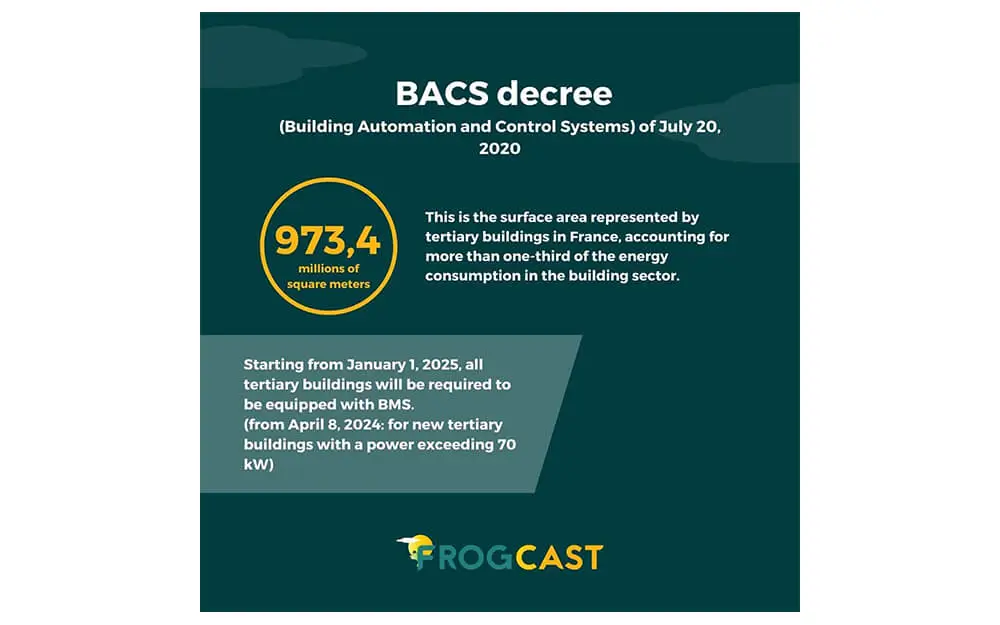
Starting January 1, 2025, tertiary buildings equipped with heating or air-conditioning systems above 290 kW must be fitted with a Building Automation and Control System (BACS), according to the decree of July 20, 2020.
Since April 8, 2024, this obligation already applies to new tertiary buildings with systems exceeding 70 kW.
How does the Building Management System (BMS) work?
Data collection and processing
A BMS operates by collecting data from physical sensors distributed throughout the building. Some of these sensors are installed indoors, while others (particularly those measuring outdoor conditions such as external temperature, solar radiation, humidity or wind) are placed on the rooftop.
The system transmits these data to a central server, which analyzes the information and makes it accessible to authorized users through the BMS interface. This interface provides an overview of building systems, complete with performance indicators, alarms and detailed reports.
Key BMS functionalities
BMS offers a wide range of functionalities that can vary depending on the specific needs of the building. Some common features include:
- Real-time monitoring: BMS collects real-time data on building conditions, such as temperature, humidity, energy consumption, and more. The system displays these data in the BMS interface, enabling facility managers to monitor building performance and identify any issues.
- Automated control: BMS enables the scheduling of automated actions to optimize energy efficiency. For instance, it can regulate temperature and lighting based on occupancy schedules, thus reducing energy consumption when the building is unoccupied.
- Alarm management: BMS generates alerts in the event of system malfunctions or exceeding predefined thresholds. Facility managers can be notified through instant notifications, emails, or automated reports, allowing them to respond promptly to issues.
- Energy optimization: BMS offers advanced data analytics capabilities to identify energy wastage areas and suggest improvement measures. This, in turn, helps reduce energy costs and minimize the building’s environmental footprint.

The challenges of physical rooftop sensors
Sensors installed on rooftops play a critical role in BMS by collecting meteorological data. However, these sensors are exposed to natural elements and may encounter various challenges.
1. Soiling issues
A major challenge for rooftop sensors is soiling. Over time, sensors collect dust, dirt, plant debris, bird droppings, and other particles. Consequently, this can compromise their performance and accuracy.
2. Environmental wear
Rooftop sensors face exposure to harsh environmental conditions. These include UV radiation, temperature fluctuations, strong winds, and precipitation. Therefore, prolonged exposure can lead to wear on the sensors and their components. This ultimately impacts their accuracy and reliability.
3. Complex electrical installations
Installing sensors requires electrical work on the roof. Additionally, this involves electrical network wiring within the building. As a result, installation becomes complex and costly.
4. Software maintenance challenges
Physical sensors require regular software updates. However, these updates can sometimes cause issues or compatibility problems.
5. Sensor malfunctions
Sensors can become defective or mispositioned. Consequently, they provide inaccurate data that affects BMS performance.
Why use meteorological data instead of sensors in BMS?
Understanding virtual sensors
Building management system relies on a sophisticated infrastructure that harnesses a wide array of physical sensors. These sensors are essential for gathering data on various conditions and components in the building, enabling BMS to operate optimally and make informed real-time decisions.
The concept of a “virtual sensor” represents a captivating and burgeoning perspective within the Internet of Things (IoT) and automation technology field. A virtual sensor replicates the functionality of a physical sensor without the need for an actual physical sensor to be present.

Benefits of virtual sensors with weather forecasts
Virtual sensors, when integrated with short-term FROGCAST forecasts, enable the anticipation of weather conditions. As a result, they facilitate load predictions. Moreover, they qualify your BMS as “Type A” according to the NF EN ISO 52120 standard.
Instead of physical sensors, you use weather forecast data as virtual sensors. Consequently, you’ll no longer have to worry about the various issues encountered by rooftop sensors.
🏄 Reducing costs and complexity
Using physical sensors has several drawbacks. Moreover, it entails a significant maintenance cost. So, how can you approach this differently?
The answer is simple: Simplify your tasks while reducing costs by replacing physical sensors with virtual sensors!
👍 Easy implementation with FROGCAST
Getting started is straightforward. First, quickly and easily input your building’s GPS coordinates on FROGCAST. Then, seamlessly integrate our forecasts into your BMS through our API in just a few clicks.
Once integrated, you’ll have access to a high-precision weather forecast. Furthermore, it optimally combines global weather models to optimize your buildings’ energy flows!
Try it for free!